
Instant Feedback - What Managers Can Learn from Airport Toilets
// Imports removed

One could think that for modern companies, the human factor loses competitive relevance through the growing intelligence of computers. But can the success of Apple, Google, Airbnb or Uber be explained by the clever use of technology? As I explained in a blog post about the Taylor Bathtub, in reality, the human being is the decisive factor.
But how do managers manage to develop their employees in such a way that they make the profitable difference? Companies such as PricewaterhouseCoopers show a way that places feedback at the heart of employee development, recognizing that one of the most important tasks as a manager is to give feedback to employees. And managers are also dependent on receiving regular feedback in order to improve themselves. But how regular and comprehensive is ideal?
Old School – General Electrics' feared annual appraisal
GE's CEO Jack Welch is considered one of the founders of the world's toughest performance reviews. Until his departure at the beginning of the 2000s, the performance of employees was not only evaluated and reflected back every year, but also a ranking list of all employees was drawn up on the basis of this evaluation. The lower 10% were subsequently fired. Besides obvious problems with this approach, there are at least two, less obvious ones:
1. Temporal connection of feedback and consequences
Imagine going to a photographer for application photos. The photographer shoots the pictures, develops them and puts them in your hand with the words: "The pose you took makes you look awkward, and your head was too high so that it didn't fit the picture completely. That'll be 70 euros." Unsatisfactory? Well, you could still have a picture taken and wait for the prints, you know what can be done better now. Unfortunately, many people feel that they are treated in the same way at annual meetings, which link the feedback and the consequences in time.
2. Long evaluation period
Long evaluation periods allow you to filter out changes in appearance and performance caused by the daily form, but do you want that? Isn't it important to know how you affect others when you are overtired or don't want to be involved in the project? Unfortunately, a long evaluation period leaves little room for such subtleties. Neither feedback givers nor feedback takers can put themselves emotionally into the situations that have led to outliers in performance and external perception in the past year. In the worst case, the consequence may be that the feedback recipient cannot accept the feedback, since he does not recognize himself in this behavior. But it is exactly these outliers who can teach us a lot about us.
Another problem with the long evaluation period is the potential failure to take change into account. Self-critical people in particular can react unhappily if they are presented with feedback that has been leveled over the past 12 months and thus runs the risk of swallowing ups and downs: "What about the positive change that I have made to myself? Isn't that something you don't see? Then why am I even doing this" are understandable reactions.
Instant Feedback – just a temporary trend?
On the other side of the spectrum is the term instant feedback. This immediate feedback is intended to keep the time between observation and feedback as short as possible. Even though some tech companies have only recently jumped on this bandwagon, instant feedback is definitely not a modern phenomenon. Whether an apprentice mechanic, a music student or Luke Skywalker, immediate feedback about the success or failure of the experiments is an essential part of an education. Is instant feedback not for academics? Is instant feedback just a new term for the frowned upon micromanagement or a hidden form of instruction? As in music lessons, three things are necessary to enable a relationship at eye level.
1. Is feedback desired?
At the thought of being criticized, many people flinch at first. Others, on the other hand, seem to rejoice when a mirror is held up to them. So are people simply different and some should not be criticized? Author Dale Carnegie even suggests in "How to Win Friends & Influence People" that one should never criticize other people for one's own good, as criticism is never desired. His 1936 argument, however, is based on a strongly self-centered worldview that is incompatible with our current network economy. Criticism is therefore necessary nowadays in order to work together efficiently. But how can you get people to want it?
2. Is there a communicated, common goal?
Carnegie's diagnosed selfishness of all people does not have to be an obstacle, but can even inspire a functioning feedback culture. What is necessary for this is the definition of a common goal. Whether as a vision statement, business plan or personal development plan, common accepted goals provide the basic framework for the acceptance of criticism. Finally, feedback shows you what stands between you and your goals.
The crux of the matter is communication. An employee and his or her manager may have the same goal, for example, to train the employee to become a manager. Although the motives are most likely different (the employee may want social status, his boss measures his success by the success of subordinates), the goal is the same. Only through communication it is now possible to achieve a common understanding of the steps and hurdles on this path. Once this is achieved, critical feedback is no longer an obstacle but a pointing out of stumbling blocks.
3. Is there an opportunity for improvement?
Without knowledge of the points of criticism and the opportunity to practice, improvement is much more difficult. Consequently, it is frustrating to be criticized for something that is beyond one's control. But should we only address what can realistically be stopped? One possible solution is to treat points of criticism such as voice or posture that are "close to the person" and "close to the body" with particular care. Even more than with all other points of criticism, the observation - effect - recommendation scheme makes sense here. In this way, the feedback receiver is allowed to accept the points that are within the scope of his or her possibilities.
Self-optimization – ignite or prevent?
Before the possibilities of instant feedback are discussed here, an important point should be mentioned beforehand: The trend towards self-optimization has become the curse and blessing of an entire generation. Blessing, as there are technical and social possibilities to support his quest for improvement. Curse, however, since the possibility often becomes a compulsion. Not only do people themselves suffer from this, who run after an ideal, but also companies that threaten to lose the diversity of their employees. Diversity is by no means to be seen here as a political end in itself, but as a catalyst for ideas and the recognition of faulty group processes. So it is important not to judge people by the same standards, contrary to intuition. A shocking example is the successful American company Zappos, which had optimized its internal "forming and sorting process" to such an extent that some employees were driven to suicide. So it is up to the managers to set different standards and offer individual development plans that correspond to the characters. These plans are of course also reflected in the categories in which you give feedback. An expert who only works internally would thus be evaluated less by his external impact than a sales employee. Also one should not want to form critical employees into good yes-sayers, but rather consider where a Devil's Advocate could benefit the company.
Possible Instant Feedback Implementations
The biggest hurdle in obtaining feedback is the effort involved. Fortunately, technology can help us here. For example, airport toilet operators use terminals that allow them to play back their opinion of the experience at the touch of a button. Here it is crucial that it is clear what is being voted on, in this case cleanliness.
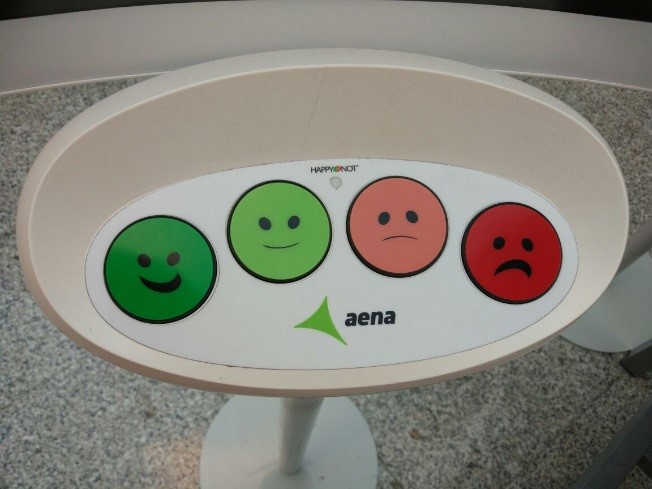
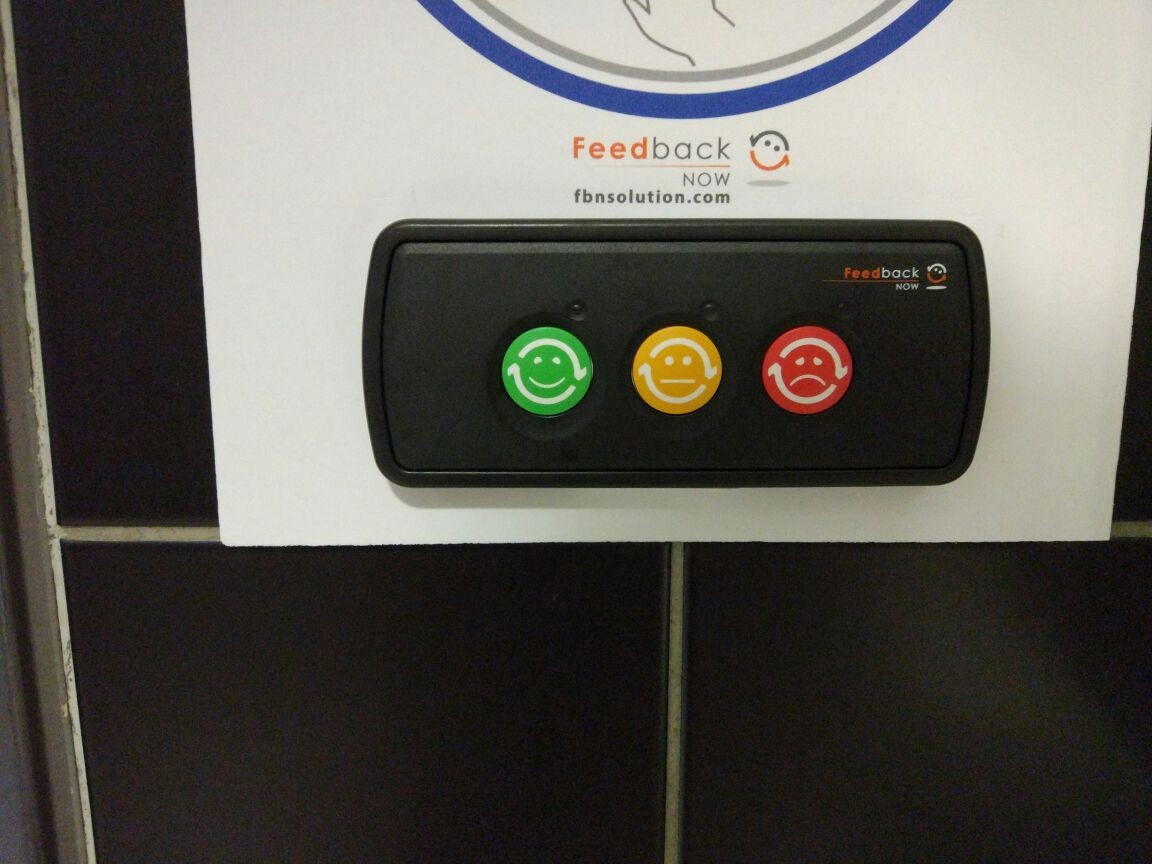
"Unfortunately" the categories in which we judge people in everyday business life are not so one-dimensional. But does it always have to be a complete picture that we get painted? Wouldn't it be enough if you defined yourself on the basis of which question (e.g. seemed well prepared) you would like to be evaluated? After a short observation period (e.g. a meeting) the participants give their feedback. The digitally recorded evaluation is then sent to the feedback receiver. Such an implementation directly fulfils essential points:
- The feedback recipient wants feedback on a self-defined point
- The feedback means no noticeable additional effort for the feedback givers
- The result can easily be sent automatically to the feedback receiver
A possible implementation would look like this, for example:
- When you book a meeting room, you automatically receive an answer asking if you want feedback about the meeting. Several valuation dimensions can be selected.
- The selected dimension appears as text on a simple display above the buttons.
- When leaving the room, participants can answer the question by simply pressing a button.
- Afterwards an email report about the result will be sent.
All points can of course be extended or simplified as required. What is your opinion? Does it make sense to move in this direction? What do you find valuable feedback information for you or others? What kind of technical implementation can you imagine? Leave me a comment, I am looking forward to your suggestions and views!
Closing Words
Feedback is becoming more and more of a business-critical resource due to the increase of the human factor as a competitive advantage, which has to be promoted and demanded. This insight does not stop at hierarchical levels or company boundaries. A feedback culture must be lived by all levels and also externally, e.g. to customers, at lectures or at recruiting fairs. This article is not intended to offer a final solution to a finite problem, but rather to start the discussion, which should no longer flatten out in a feedback culture: How can we ensure that all levels and people receive the feedback they need to make all of our collaborations better? Feedback is not only an opportunity for self-improvement, but also an opportunity to reflect on one's behaviour and work on others. It is therefore very much about functioning cooperation and less about individual services.
If managers succeed in introducing a healthy feedback culture, they lower the hurdles to open and honest communication, which is a decisive step towards a profitable difference.
About the Author

Kevin Rassner is an expert in applied organizational development, supporting companies through transformation processes that span strategy, leadership, and culture. He combines over ten years of leadership experience with a systemic perspective on effective collaboration.
About the Author
Kevin Rassner is an expert in applied organizational development, supporting companies through transformation processes that span strategy, leadership, and culture. He combines over ten years of leadership experience with a systemic perspective on effective collaboration.