
Why Elon Musk Did Not Become a Cave Rescuer
// Import removed
Even if I try to reflect (week-)daily on my work, the distance that results from actually leaving my job cannot be replaced by anything. This can be a longer holiday or a change of jobs. And so it was only now, when I left my position as team manager behind me, that some interesting insights came to me. Findings about the team, about individual employees and about my own work. At some realizations the causes and dynamics were obvious, others were not immediately obvious to me. So I went looking for scientific explanations. Although I am a big fan of emotions, I would like to support these subjective insights with solid theory.
Is incompetence a quality of leadership?
Looking at the professional orientation of my team and my CV, one question quickly arises: Why is someone who has no experience in the field of Machine Learning and Artificial Intelligence a team manager of this very topic? The reason for this was that at the time of my nomination as a prospective team manager I was faced with the choice of the technical topic I wanted to take up. Two topics, which can be described as core competences of the company, were put to me for selection. Since I had little interest in either of them, I suggested a third topic, namely machine learning. I based my decision on the following criteria:
- the most fun?
- best learning opportunity?
- a guarantee of professional success?
I admit that these criteria seem very selfish - because they are. But they are also all beneficial to the company: Fun inspires performance, learning inspires growth and professional personal success is often measured by business success. Without knowing it, I made a decision from the full solution space, which was very good for the company.
A little knowledge is a dangerous thing. So is a lot.
Not Albert Einstein
The team of professionals I formed quickly became the fastest growing team in the company, from one to 17 employees in the first year. I don’t want to say that a machine learning expert would have done a worse job than I did, but rather that it was my unprejudice that allowed me to find this solution.
During the subsequent team management, too, my lack of knowledge of the subject could not be dispelled. I was able to quickly acquire the basics in order to understand which topics my team members were working on. But I never gave in to the fantasy of quickly gaining expert status.
You really must almost come with a child’s mind to imagine what could be and how you can look at it in a completely fresh way.
Mark Levy, author and consultant, about leadership qualities
Recognizing the lack of knowledge promotes cooperation
Needless to say, I had to rely on the technical knowledge of my team members in order to make strategic decisions. Looking at the research in this field, I fulfilled an essential condition to find the right solutions in these turbulent times of rapid growth. Harvard professor Amy Edmondson describes in her research that the following three leadership qualities are necessary to lead a team to success in turbulent environments:
- Situational modesty, the ability to recognize if you don't know the answer
- Curiosity, i.e. the ability to give way to other opinions and suggestions for solutions
- Psychological stability, i.e. the possibility to be a support for the team members
So it seems that in hectic situations, the human rather than the professional skills of leaders are more important. This also explains why these properties are primarily sought in scrum masters (with agility as a synonym for planned turbulence).
Is teambuilding outdated?
Edmondson’s research thus deals with a concept which in my opinion deserves the leap from the niche into the spotlight. Her field of research, the so-called teaming, is an extreme form of teambuilding, which can be observed in its pure form especially in environmental catastrophes and humanitarian disasters. In these situations, the group of people must solve problems without having trained together. There are also no other prerequisites for classic teambuilding:
- The group has no time to build trust, get to know each other or communicate extensively about common goals.
- But there is also another problem: Teambuilding is about teams that are stable by definition and do not consist of constantly changing participants.
Even if corporate jargon likes to use catastrophe rhetoric, corporate problems are not a matter of life and death. Can the Teaming concept still be used?
In my opinion, we have never been to the point in the business world where real teambuilding can work. And there are trends that worsen that: constantly changing team composition and goals, working in different time zones and locations and growing complexity that obscures the supposedly common goals.
Teaming is therefore probably more present in agile environments than we are aware of. I would therefore like to take a case study from the field of teaming in catastrophe situations and project it onto concepts from everyday business life.
Los 33 as a prime example of successful teaming
The first case study deals with the Chilean mine accident of 2010(opens in a new tab), when 33 workers were caught in a mine accident at a depth of 688 meters. Only after 2 weeks the men could be supplied with food and drink, after 69 days the rescue succeeded.
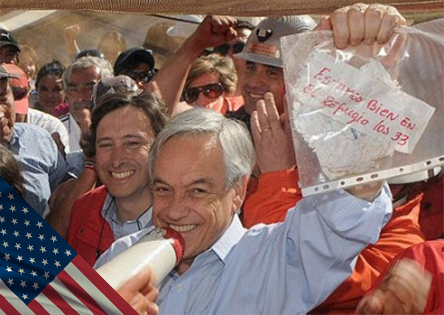
The picture shows the message: "Estamos bien en el refugio, los 33," which was tied to a drill head, which was pulled out of one of the many fist-thick exploration holes after 17 days.
| Mine Disaster | Company Lesson | | --- | --- | | The shift supervisor rationalized the supplies to a spoonful of tuna and a sip of milk every two days for each miner, weighing consequences. | Explain the why and set a good example. | | NASA supported the rescue with expertise in nutrition. | Promote and demand cooperation across resort boundaries. | | Drilling specialist Brandon Fisher developed a specific drill for the challenge. | Creativity can come from outsiders. | | NASA and North American drilling experts joined after hearing in the press. | Publish problems to create solutions. | | Even soft factors - cigarettes, family, national team updates - were prioritized. | Don’t forget the soft factors; everyone can contribute. | | Three parallel rescue projects, most failed, breakthrough by the unlikely idea. | Fail often; diversify approaches. | | Endless hours, all worked tirelessly. | People want to do good; enable it. | | Shift leader Luis Urzúa was last out, credited with his team’s intactness. | Servant leadership. | | Decisions were made democratically. | Leader is part of team, not above it. |
In the end, it was the human qualities of leaders (Brandon Fisher’s selflessness, Luis Urzúa’s courage and humor) that led to success.
You just have to speak the truth and believe in democracy. Everything was voted on; we were 33 men, so 16 plus one was a majority.
Luis Urzúa, Shift leader
What was Elon Musk doing wrong?
The recent cave disaster in Thailand shows many parallels to the Chilean disaster. Among the helpers was Elon Musk. However, the Twitter dispute between Musk and a rescue diver became more famous than his efforts. Musk seemed to criticize the local competence, which contradicts the first condition for successful teaming. Musk is both ingenious and ambitious - but was his expertise a hindrance?
If human skills matter more than technical ones in disasters, what does this mean for leadership in turbulent business? Solutions such as part-time management for extra-occupational social training are apparent to me.
Looking back, my lack of machine learning knowledge forced me to focus on other skills, which research now suggests is vital for future leadership. After a break as a househusband, I will start anew - without machine learning, but with blog insights and servant leadership.
About the Author

Kevin Rassner is an expert in applied organizational development, supporting companies through transformation processes that span strategy, leadership, and culture. He combines over ten years of leadership experience with a systemic perspective on effective collaboration.
About the Author
Kevin Rassner is an expert in applied organizational development, supporting companies through transformation processes that span strategy, leadership, and culture. He combines over ten years of leadership experience with a systemic perspective on effective collaboration.